

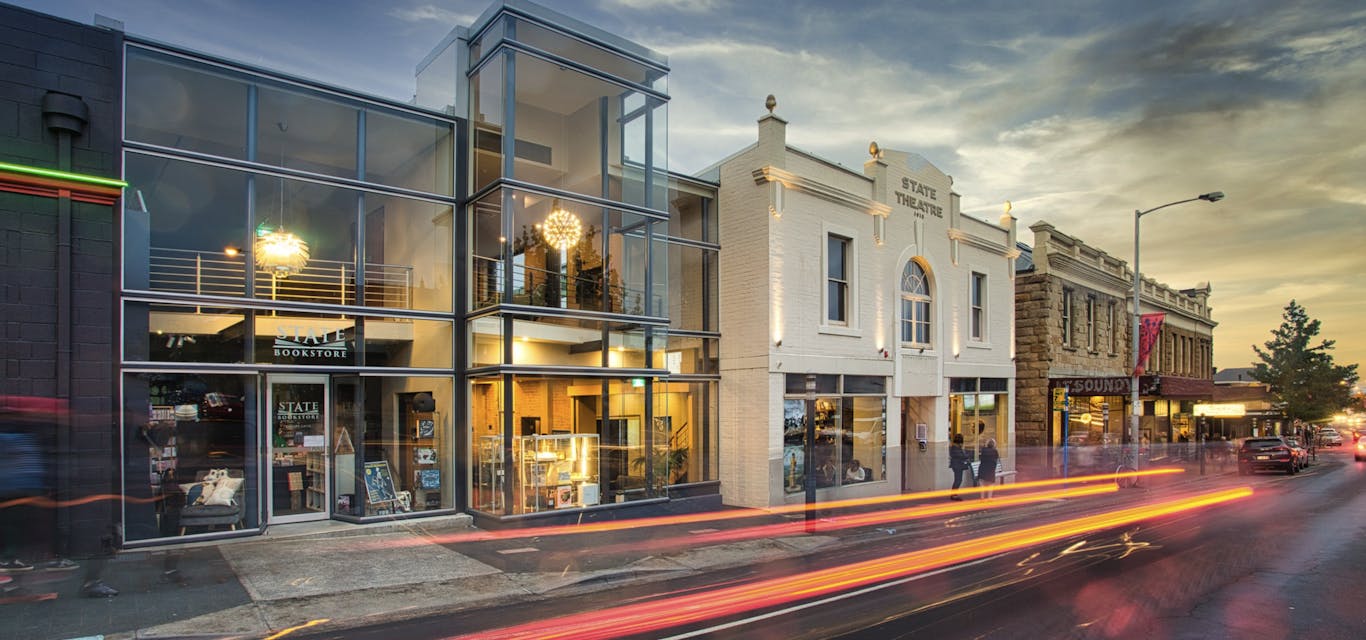
At this 1913-era icon, nothing beats a big screen – except a choc top
More than a movie house, The State Cinema has survived wars, television and the digital age.
Before streaming took over our lounge rooms, North Hobart’s State Cinema was where Tasmanians went to be transported. For more than a century, this neighbourhood icon has been part of the city’s story, the place for first dates, school excursions, family outings and quiet solo escapes.
The State Cinema has endured because it keeps evolving while staying true to its community spirit: part cinema, part meeting place and part time capsule of Tasmanian life.
Regular patron Mandy Cotman says it best. “From the moment you step through the glass doors into the beautifully restored building, you feel welcomed. I always make time to browse the bookshop before grabbing a glass of wine and settling into one of the red cushioned chairs.”
The building itself tells stories as rich as the films it screens.
Look up in Cinema One and you’ll still see the pressed tin ceiling from 1913. “It’s remarkable to think that millions of people have sat under that same roof,” says John Kelly, the local businessman who bought and restored the cinema. “Soldiers who went away to the war and never returned, couples on first dates, people whose life could be turned around by seeing someone do something, or a place or a building.”
That shared hush as the lights dim and the story begins is what keeps people coming back. The State isn’t just a cinema. It’s part of Tasmania’s cultural heartbeat.
Humble beginnings
The story starts in 1913, when two businessmen, Edward Morris and Alfred Chenhall, spotted an opportunity. As live theatres across Hobart began screening motion pictures, the pair decided the city needed a purpose-built movie house.
When Alfred discovered Badcock’s Fuel Depot for sale on Elizabeth Street, they found their site. The old sandstone building was demolished and replaced with a two-storey double-brick hall with a galvanised iron roof and pressed tin ceiling. The North Hobart Picture Palace officially opened on 2 October 1913, seating around 500 people.
Locals affectionately called it “the Hall”, and from its very first screening it became a community favourite. For many Tasmanians, this was their first experience of film, the flicker of light on faces, the hum of the projector and the collective gasp when the story unfolded.
Struggles through World War I
When war broke out in 1914, the Picture Palace threw its support behind the troops, screening patriotic films and hosting fundraising events. A year later, a new lessee, a New Zealander, renamed it the Melba Picture Theatre in honour of Dame Nellie Melba, who had toured Tasmania that winter.
But the war took its toll. With so many men away and the economy faltering, audiences dwindled. Then came the Spanish flu pandemic. Like picture theatres everywhere, the North Hobart Picture Palace closed its doors, its glory days seemingly behind it.
In the 1920s, the hall was repurposed as a billiard saloon. The building survived, but the magic was gone until 1935, when entrepreneur Wilfred Kemp decided to bring the silver screen back to North Hobart.
A new name, a new era
Wilfred had vision. He redesigned the façade in striking art deco style, installed a sound system and added wider-than-average seats. On Friday 28 June 1935, he unveiled The Liberty Theatre with a screening of The Gay Divorcee, a musical comedy starring Fred Astaire and Ginger Rogers.
For a time, it thrived. But within six months his company went into liquidation and in 1936 the building was sold again. New owner Norman Wilson kept it going, and when World War II broke out, The Liberty became the first cinema in Hobart to screen war-related newsreels.


Becoming the State Cinema
In 1948, new owners Ross Holyman and Gordon Garnet Gourlay purchased The Liberty Theatre and renamed it the State Theatre. They repainted, re-carpeted and rewired the building, installed Tasmanian-made sound equipment and imported 390 seats from the mainland. The revamped cinema reopened on 20 August 1948 and quickly found its audience again.
For a while, the State thrived. Families came for Saturday matinees, couples for evening screenings and newsreels kept locals informed about life beyond Tasmania. But by the 1950s, a new rival arrived: television. Slowly, the crowds thinned. By Christmas Day 1973, the State’s doors closed once again. The building stood empty, its future uncertain, until a familiar storyline of rescue and reinvention began to play out.
A government rescue
Enter Phillip Adams, then head of the Australian Film Institute. Recognising the building’s heritage value and cultural importance, Adams worked with Gough Whitlam’s government to secure its purchase on behalf of the Film, Radio and Television Board of the Australia Council for the Arts.
The plan was ambitious, a full restoration funded by the federal government. New paint, carpet, seating, wiring, film equipment and air conditioning were all installed, a process that took 18 months and cost around $100,000.
When the AFI State Cinema reopened on 13 February 1976, Gough Whitlam, now Leader of the Opposition, attended the launch. The moment marked not just a reopening, but a revival of Hobart’s film culture.
The community’s turn
By the 1980s, the State had become more than a theatre, it was a social institution. Adrian Jacobson was appointed Cinema Manager and his leadership brought renewed life to the venue.
When the AFI board announced plans to sell the cinema in 1984, locals protested fiercely. A community campaign stopped the sale, and the State soon became the first cinema in Hobart to hold a liquor licence. With a glass of wine in hand, movie-going suddenly became an even more social affair.
Tasmania’s other classic cinemas
Star Theatre, Launceston
The Star Theatre’s art deco facade, designed by Tasmanian architect Guy Crick, is a gem from the golden age of cinema. Opened in 1937, it ran until 1969 before becoming a St Vincent de Paul outlet. Lovingly restored, it now operates as an independent cinema with a cafe, bar and live music events.
Rewind Cinema, Hobart
For lovers of cult classics, Rewind Cinema has brought big-screen nostalgia back to Hobart. It first opened in 2022 at the Kickstart Arts complex in New Town, screening VHS-era favourites and arthouse gems from the ‘80s and ‘90s. After venue challenges forced its closure, Rewind re-emerged with pop-up screenings across the city, celebrating the joy of watching films together.
Rebuilding the magic
By the early 2000s, funding cuts again forced the AFI to sell. Heritage protections kept demolition at bay, but fears grew that a big cinema chain would take over. Local businessman and councillor John Kelly, who had grown up with the State, made an offer.
“I used to go to the cinema for school excursions, and as a teenager I took girlfriends there,” John says. “It’s always been part of my neighbourhood and a cornerstone of the North Hobart community.”
Endorsed by Adrian, John’s offer was accepted in September 2002. “It was your classic suburban dusty hall,” he recalls. “Apart from being a patron, I’d never had experience in the cinema industry. What I had was fresh eyes and a business perspective.”
John joined the Independent Cinema Association and discovered how independent cinemas were surviving, through diversification, improved technology and stronger community ties. He introduced digital projection, improved sound, installed a modern computer system and launched a website.
But change didn’t come easily. Some locals and heritage bodies resisted his renovation plans, but after a large financial loss in 2003, John knew action was vital. In 2005, he began merging the adjacent Soundy’s department store building with the cinema. A new upstairs cinema seating 30 opened in 2006, and the 1948 awning was removed to reveal the original 1913 façade.
A continued evolution
Over the following years, more screens were added, including one underground. “We dug 4m deep and removed 400 tonnes of earth,” John says. “I did the excavation myself to save money, and it felt like therapy.”
Despite the construction chaos, the cinema stayed open. “Seeing 60 people sitting in a dark room, completely absorbed in a film, made it all worthwhile,” he says.
By 2011, the State had evolved again. A rear extension added a cafe, wine bar, outdoor balcony, rooftop cinema, commercial kitchen and bookshop. “The cafe and bar are a lovely place to meet friends you haven’t seen in a while,” says patron Ruth Dawkins. “You can grab a drink before a film or relax with one afterwards.”
After nearly 20 years of transformation and an estimated 250,000 annual patrons, John decided to sell in 2019. “It’s like an old girlfriend,” he says with a wry smile. “There comes a time when you have to move on.” Reading Cinemas purchased the State later that year, adding it to its international portfolio.
Cinema enthusiasts can dive deeper into the State’s story in A Century of Cinema: The Life and Times of the State Cinema by Bill Clyde. Copies are available from the State Bookshop in the State Cinema.