

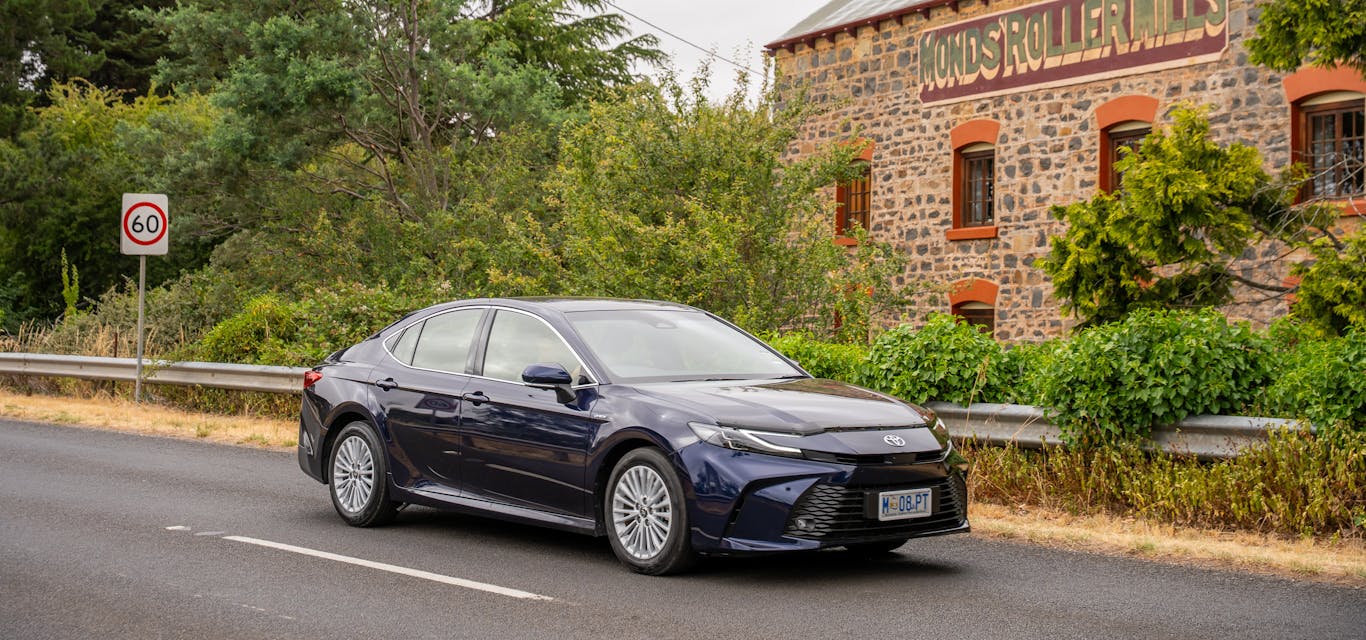
Road test: Camry Ascent Sport
A slow arc through northern Tasmania, from Carrick to the Great Western Tiers, puts the Camry Hybrid somewhere between past and present.
In the farmland around Carrick, the roads are framed by hawthorn hedgerows and the fields are dotted with hay bales. As I drive towards the Great Western Tiers, I feel almost as though I’m motoring across the set of an English period drama. It’s a timeless rural scene, and I’m suitably viewing it from a timeless sort of vehicle.
The Toyota Camry has been on Australian roads for more than four decades, and for many people its reputation remains solidified as a sensible car for sensible families. But as I head across this farmland, there’s a surge of power each time I tap the accelerator, and digital readouts keep me briefed on my fuel economy and use of EV power.
With this new-breed Camry upgraded to a ‘fifth-generation’ hybrid electric system in 2025, is it still just a car as comfortable as a knee blanket, or has the Toyota Camry come back to the future?
My vehicle today is the Camry Ascent Sport, the middle tier of the Camry’s three models: Ascent, Ascent Sport and SL. All three are available only as hybrid vehicles, and they defy modern trends by the fact that they’re all sedans. As I drive out of Launceston, I’m seemingly the lone sedan in a pack of SUVs and utes, happily unfashionable as I head towards the belt of historic colonial towns – Hadspen, Carrick, Westbury – to the south of the city.


Turning onto the Bass Highway, there’s a moment to open out the throttle, and the car responds beautifully, before I turn off this modern motorway into history’s lanes.
In Carrick, I pause by the Liffey River and take my first literal gauge on the drive. When I turn off the engine, the Camry’s simple but sufficient digital instrument panel provides an overview of the drive segment just completed. Data displayed includes percentage of time spent in EV mode – at up to 60% on this day, it’s often surprisingly high – and average fuel consumption. Toyota claims that the Camry’s 2.5-litre engine sips just four litres per 100 kilometres, which would give the fuel tank a range in excess of 1200 kilometres, though today it’s running at around five litres per 100 kilometres.
Carrick has all the accoutrements of an historic Tasmanian town: a 19th-century inn and flour mill, and the almost Gothic ruins of a grand home, built by John Archer in 1847 (and forever known now as Archer’s Folly). But in the hinterland behind Carrick there are different histories, from a touchstone of Tasmania’s conservation movement to the full flow of natural history at Liffey Falls. It’s here that I steer next, turning south from Carrick and weaving through Bishopsbourne and Bracknell to the foot of the Great Western Tiers.


As the road returns to the bank of the Liffey River, the world is transformed, with forest suddenly replacing farmland as I pull into Oura Oura. Backed by the high escarpment of Drys Bluff, the 25-hectare block was once the home of Australian Greens leader Bob Brown, who donated the land to Bush Heritage Australia to ensure its ongoing protection.
As I return to the vehicle after a walk around Oura Oura, I’m struck by the twin personalities of the Camry. It’s both powerful and efficient, and the shift from electric power to petrol when driving is barely perceptible.
Seen front-on, the car appears angular and racy, looking styled for fun, while side-on it still looks styled for a family. It doesn’t turn heads but drive it and it feels like you’re harbouring a secret – the Camry is cool.
This newest model is also slightly longer than past iterations of the Camry, giving the interior a smidge more room, while opening the spacious 524-litre boot is like meeting the Tardis.
From Oura Oura, the road and the river wriggle west together for a few kilometres, the road turning to gravel as it begins up the slopes of the Great Western Tiers. It’s not the natural terrain for a midsize sedan, but the Camry glides up the hill unfazed, riding smooth even over the few corrugations and small washouts as I ascend to the top car park at Liffey Falls. On foot, I follow the river’s cascading journey through the tall timber to the base of one of Tasmania’s signature waterfalls.
I turn back north at the falls, driving down the slopes towards Deloraine. It’s a serpentine drive on Highland Lakes Road, coiling through the forest. The Camry is low-slung and grippy, making for a fun descent, and my sense of nostalgia spikes each time I notice the cloth seats and the doors’ plastic lock buttons. Yet there’s also a 12.3-inch touchscreen display, a wireless phone charger neatly housed under the dashboard, and five USB-C charge outlets, enough to make the car feel like a mobile power bank.
After a late lunch stop at Frank & Lotti in Deloraine – where I score its last empanadas – my final date with history is in Westbury. Entering town, past its cottages and village green, it’s like I’ve returned to the period-drama set. And as the Camry boots away from town, back towards Launceston, at a touch of the accelerator – and I check my driving stats on the instrument display – I’ve forgotten my preconceived notions of the Camry as a car for Uber drivers and cardigans. For the moment, I feel like the most modern thing in town.

