

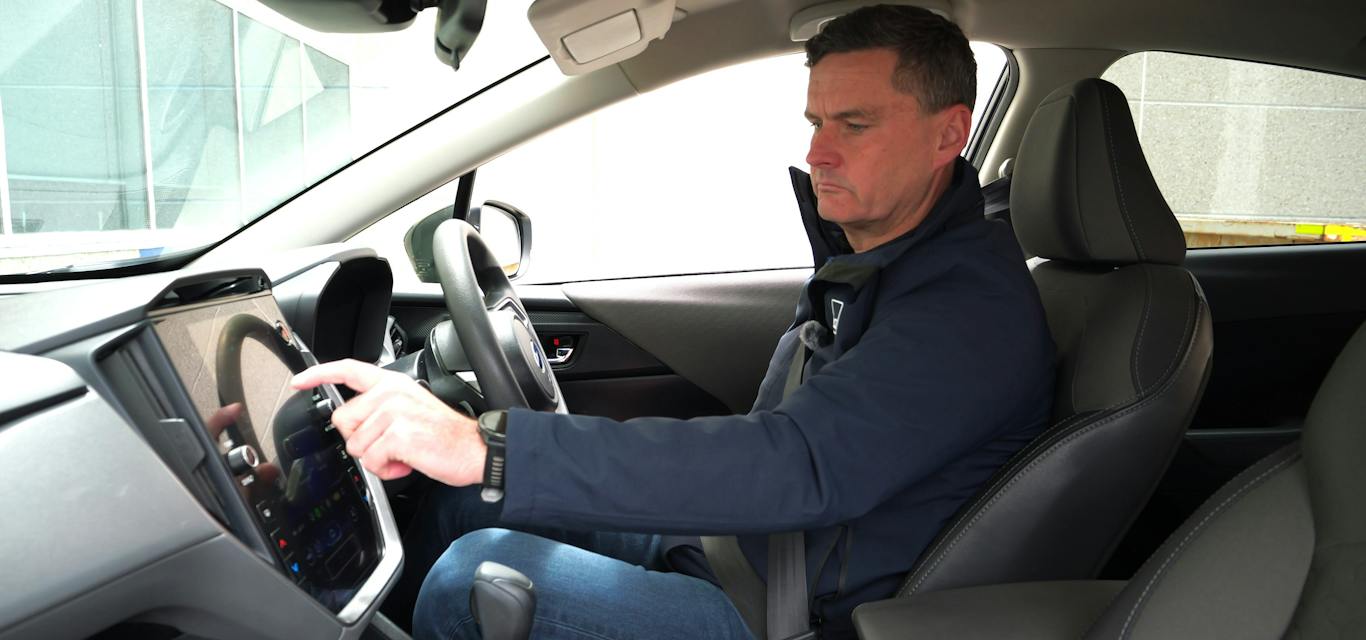
How distracting is your car? New test puts in-car technology under the spotlight
Published | 9 November 2026
A new online tool is giving drivers the chance to test how distracting their car's technology can be, as RACT and the Australian Automobile Association (AAA) warn motorists to stay focused behind the wheel.
The first-of-its-kind research commissioned by Australian automobile clubs and conducted by the University of Newcastle, found significant differences between popular vehicle infotainment systems, with Apple CarPlay rated the least distracting, and native systems in the Polestar 2, Ford Ranger and Toyota Corolla the next best performers.
RACT's Chief Mobility Officer Dean Harris said the findings were particularly important for Tasmania, where inattention and distraction contribute to nearly a quarter of fatalities and serious injuries on the state's roads.
"The road statistics tell us that as of September 25 people have tragically lost their lives on Tasmania's roads**. In 2025 we recorded the largest increase in road deaths of any Australian state, highlighting the need for motorists to remain focused behind the wheel," he said.
"With more technology built into modern vehicles, understanding how these systems affect driver attention is increasingly important.
The AAA research assessed a selection of popular vehicle infotainment systems against common and legal tasks, including making and receiving phone calls and texts, playing music and using navigation.
“Systems were awarded a star rating based on the number of steps required to complete each task, with a maximum five stars for tasks taking one to two steps and zero stars for those requiring 11 or more.”
University of Newcastle researcher Dr Rachael Wynne said Apple CarPlay was the least distracting of the systems tested.
"Apple's infotainment system scored five stars with an average of two steps per task," Dr Wynne said.
"The Polestar 2, Ford Ranger and Toyota Corolla's systems were the next best, scoring four stars with an average of three steps.
"At 80km/hr, for each second your eyes are off the road, you are essentially driving blind for over 22 metres – so for every extra step you have to take, the distraction really adds up."
Mr Harris said the findings were a reminder for drivers to prepare their vehicles before setting off and avoid interacting with technology while driving.
"There's no such thing as a safe amount of distraction when you're driving. We want motorists to think about how they're interacting with their cars and make sure they're using the technology as safely as possible,” he said.
"Put your mobile phone away and finish any calls or messages before you drive, set your GPS and work out where you're going before leaving, and make sure children and pets are settled and secure.
"Once you're on the road, don't drive tired or under the influence, take breaks on longer journeys and, if something needs your attention, pull over somewhere safe. Some tasks simply shouldn't be performed while driving."
Tasmania's road death rate was 7.6 per 100,000 residents in 2025, compared with the national rate of 4.8.
RACT is calling for a stronger, long-term approach to road safety through its submission to the State Government's next Road Safety Strategy.
"RACT's submission calls for a fundamental change in how we prevent deaths and serious injuries on Tasmania’s roads. That means stronger speed management, more automated enforcement, 100% of speed camera revenue reinvested directly into road safety, and a public 40-year plan to upgrade our highest-risk roads,” Mr Harris said.
Mr Harris said reducing road trauma required motorists to make safer decisions while governments also committed to improving the road network.
The results for the 10 infotainment systems tested, including their average number of steps and star ratings, are outlined in the table below.
For more information and to test your vehicle's infotainment system, visit www.aaa.asn.au.
**Latest information from www.transport.tas.gov.au as at September 2026 and noting subsequent fatalities have occurred post this update.

